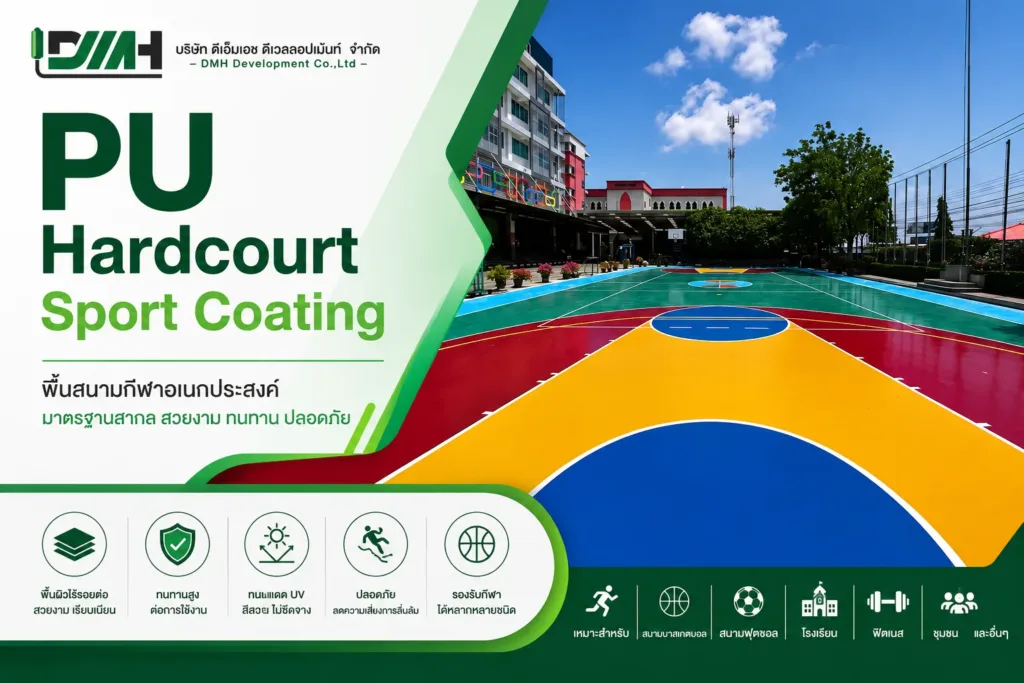
PU Hardcourt Sport Coating — PU Sports Flooring
A Polyurethane (PU) sports court coating system — strong, flexible, and more durable than Acrylic. Ideal for tennis, basketball, badminton, futsal, and multi-purpose courts.
- Strong, built for heavy use
- Consistent, accurate ball bounce
- Withstands strong sun, holds its shade well, resists cracking
- Slip-resistant, with good grip wet or dry
What is PU Hardcourt Sport Coating?
PU Hardcourt Sport Coating is a sports court surfacing system using Polyurethane (PU) designed specifically for sports courts. It gives a strong, smooth, flexible surface that outlasts standard Acrylic systems, suiting sports that demand fast, precise movement.
Polyurethane outperforms ordinary court paint in several ways — flexibility, UV resistance, impact resistance and service life — which is why the system is widely used for outdoor sports courts, including tennis and basketball courts.
DMH Groups installs PU sports flooring both indoors and outdoors for every type of sport, at thicknesses from 2–10 mm depending on the intended use and budget.
How is PU Hardcourt different from Acrylic Hardcourt?
A common question is how PU and Acrylic differ, and which to choose. The answer depends on usage, budget and the level of durability you need:
| Item | PU Hardcourt | Acrylic Hardcourt |
|---|---|---|
| Flexibility | High | Moderate |
| UV resistance | Excellent | Good |
| Service life | 7–12 years | 5–8 years |
| Ball bounce | Very consistent | Consistent |
| Heavy-use durability | Very high | Good |
| Price | Higher ฿฿฿ | More economical ฿฿ |
| Suitable for | Competition courts in continuous heavy use | Training courts, schools, community facilities |
In short: if you need a longer service life and heavy-duty performance → choose PU Hardcourt. If the budget is limited and it is a general training court → Acrylic is enough.
Key features of the PU Hardcourt Sport Coating system
Strong, built for heavy use
Polyurethane resists impact, abrasion, and repeated running many times better than ordinary acrylic court paint, making it ideal for courts used daily by large numbers of players.
Consistent, accurate ball bounce
An evenly smooth surface across the whole court means the ball bounces true and predictably — ideal for club-level competition and training that demands precision.
Withstands strong sun, holds its shade well, resists cracking
The PU formula contains a UV stabilizer that helps protect against fading and cracking from sunlight over the long term, so the colors hold their shade well over a 7–12 year service life.
Slip-resistant, with good grip wet or dry
The surface is blended with a friction additive that gives the right grip in both dry and wet conditions, letting players change direction, stop, and push off with confidence.
Absorbs impact and helps prevent injury
The flexibility of PU absorbs impact from running and jumping, reducing cumulative stress on knees, ankles, and shins — suitable for players at every level.
Wide colour choice, logos available
Every shade is available, from standard court colours to custom specials, and logos or patterns can be sprayed onto the PU surface once it has fully cured.
PU Hardcourt systems offered by DMH Groups
PU sports court systems come in several forms, each suited to different uses and budgets. DMH Groups offers them all:
1. Standard PU System
The base structure of the PU Hardcourt system: Primer + a flexible PU layer + a surface coat, 2–5 mm thick. It delivers a good balance of durability and price, and suits general school and university courts.
2–5 mm thick | 7–10 year service life | sensible price | ideal for schools and universities
2. Silicone-PU (Si-PU) System
Silicone is blended into the PU formula, improving flexibility, slip resistance, and resistance to extreme weather, while keeping a slightly softer feel than Standard PU. Ideal for club- and regional-level competition courts.
4–8 mm thick | 8–12 year service life | better slip resistance than Standard | ideal for competition courts
3. Multi-Layer PU System
A multi-layer system with a foam / rubber cushion layer, a PU seal layer, a PU coating layer and a colour topcoat. It offers high impact absorption, flexibility and an even surface, and suits competition venues and indoor courts with demanding requirements.
6–10 mm thick | 10–15 year service life | high specification | suits national / international venues
Sports that suit PU Hardcourt
Tennis courts
PU Hardcourt is very popular for ATP/WTA-standard tennis courts, both outdoor and indoor, giving a Medium-Fast ball speed that competition play calls for. The surface holds up better than Acrylic in Thailand's hot, humid climate.
Basketball courts
Outdoor basketball courts in especially heavy use — community courts, universities, or clubs. PU withstands repeated running, jumping, and hard landings better and longer than other court surfaces.
Badminton courts (indoor)
The PU Multi-Layer system is ideal for indoor badminton courts, giving a surface that is neither too fast nor too slippery, so players can stop suddenly in safety. It also resists scuffing from indoor shoes.
Futsal courts
PU gives a surface where the futsal ball rolls consistently without bouncing too hard, suiting both indoor and outdoor courts, and standing up well to high-friction futsal shoes.
Multi-purpose courts
Courts that host several activities — sport and otherwise — such as school courts, community sports grounds, or private sports centres. PU Hardcourt handles varied use, cleans easily, and resists stubborn staining.
PU Hardcourt floor structure (layer by layer)
A properly specified PU Hardcourt system is built from several layers, each with a specific job, all working together:
Primer / Sealer — the base layer
Penetrates the concrete or asphalt base, seals the pores and improves adhesion between the substrate and the PU layers above, reducing the risk of blistering and delamination over time.
PU Leveling Layer — the levelling layer
A high-viscosity PU layer that fills hollows and joints in the substrate to give an even surface before the main layers. It is especially important on courts that need accurate ball bounce.
PU Elastic Base — the main flexible layer
The main PU layer that sets the court's flexibility and impact absorption, applied to the required thickness (2–8 mm). It is the heart of the PU Hardcourt system.
PU Texture Coat — the grip and anti-slip layer
Blended with an anti-slip aggregate to give a slip-resistant surface that grips shoes in any condition, with the level of friction tuned to the sport.
Color Coat + Line Marking — colour and court lines
The court is painted to standard and sealed with a UV topcoat that helps protect the color from fading, then the lines are marked precisely to the standard for each sport.
How a PU Hardcourt is installed
Installing a PU system takes expertise and experience, because every layer must dry and cure properly before the next goes on. The DMH Groups team follows a clear sequence:
- Survey and surface preparationWe inspect the concrete or asphalt, measure moisture, check for cracks, grind the surface with shot blasting or a grinder, and remove oil, dust, and dirt.
- Repair and levellingCracks are repaired with PU Crack Filler and uneven areas levelled with PU Leveling Compound, then left to cure fully. A properly levelled base gives a better final result.
- Primer and Sealer applicationPU Primer is applied across the area and left 4–8 hours to dry, then a Sealer coat closes all remaining pores. This stage determines the long-term durability of the whole system.
- PU Elastic layer applicationThe flexible PU layer is applied to the specified thickness (2–8 mm), sometimes over several passes depending on the thickness required, with drying time between passes. Weather affects drying time.
- Texture Coat and colourPU Texture Coat is applied with the anti-slip additive, then two coats of court colour, finished with a UV Topcoat. Colours follow the sport's standard or your preference.
- Line marking and handoverCourt lines are marked to the standard for your sport using durable specialist paint, quality is fully checked, and the court is handed over with a workmanship warranty.
Advantages and things to know about PU Hardcourt
Advantages
- Highly durable, handles heavy use well
- Long 7–12 year service life
- Consistent, accurate ball bounce
- Good slip resistance wet or dry
- UV-resistant and holds its shade well
- Works both indoors and outdoors
- Easy to maintain and clean
Things to know
- Costs more than Acrylic
- Requires specialist installers
- Needs drying time between layers (takes longer)
- The surface must be well prepared before installation
- Wait 5–7 days before full use
- Spot repairs are possible but colour matching needs care
Caring for a PU Hardcourt surface
With the right care, the service life can be extended beyond 12 years:
Daily cleaning
Sweep away dust and leaves every day, and wash with plain water or a cleaner free of strong acids or alkalis. Do not use bleach or corrosive chemicals.
Annual inspection
Check for small cracks, blisters, or damaged spots once or twice a year and repair them before they spread — it saves a great deal on long-term maintenance.
Resurfacing
After 5–7 years of use, a fresh topcoat restores the surface texture and colour. It costs far less than rebuilding the court and adds another 4–6 years of life.
Re-marking the lines
Court lines fade before the surface does. We recommend re-marking every 3–5 years, or whenever the lines become hard to see, using only specialist paint that bonds well to PU.
See the material specifications used in this system: Acrylic Sports Court Topcoat
Frequently asked questions
Can PU Hardcourt go over existing cracked concrete?
How long does installation take?
How much does a PU Hardcourt surface cost?
Can logos or custom patterns be added?
Can PU handle Thailand's high heat?
Interested in a PU Hardcourt sports floor?
Free site survey and quote nationwide — installed by the professional team at DMH Groups