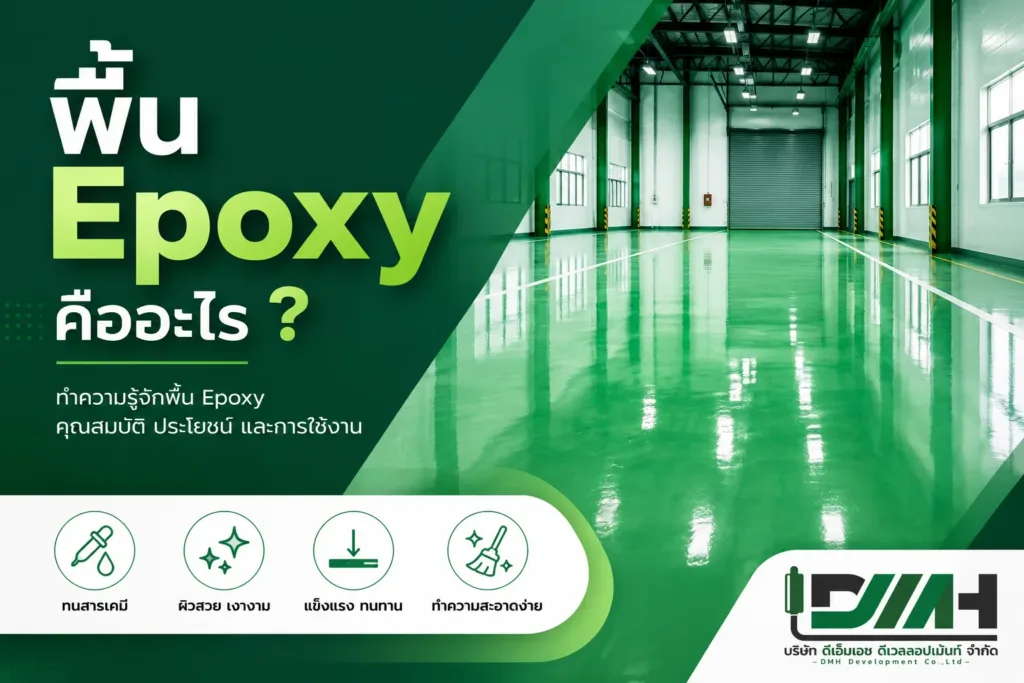
Epoxy Coating: roller-applied epoxy flooring
A roller-applied epoxy floor coating with a smooth, dustproof, chemical-resistant surface that is easy to clean. Suited to factories, warehouses and industrial areas.
- Strong, impact and abrasion resistant
- Resists chemicals, acids, alkalis, and oils
- Resists water seepage, easy to clean
- Attractive, with a wide range of colors
What is Epoxy Coating (roller-applied)?
Epoxy Coating is a floor coating based on epoxy resin. The epoxy resin is mixed with a hardener (curing agent) at a set ratio, and the chemical reaction that follows (curing) leaves the surface strong, smooth and highly durable.
Roller application (roll coat) means the coating is applied directly to the floor with a roller, much like ordinary painting, but the result is much stronger and more durable. Each coat is 0.1–0.3 mm thick, and several coats are applied to build up the required thickness and properties.
Roller-applied Epoxy Coating suits areas that need a strong, chemical-resistant, water-resistant floor that is easy to maintain, at a lower cost than a poured Epoxy Self-Leveling system, so it fits a wide range of budgets.
How does Epoxy Coating (roller-applied) differ from Epoxy Self-Leveling (poured)?
Both systems use epoxy, but the application method and the results are clearly different:
| Item | Epoxy Coating (roller-applied) | Epoxy Self-Leveling (poured) |
|---|---|---|
| Application method | Applied with a roller | Poured and spread |
| Thickness | 0.1–0.5 mm | 1–5 mm |
| Surface smoothness | Moderate | Very smooth, high gloss |
| Price | More economical ฿฿ | Higher ฿฿฿ |
| Installation time | Faster | Longer |
| Suitable for | Factories, warehouses, general offices | Labs, hospitals, high-end showrooms |
Rule of thumb: for a tighter budget, fast installation and general use → roller-applied Epoxy Coating | for a very smooth, glossy finish suited to GMP/HACCP facilities → Epoxy Self-Leveling
Roller-applied Epoxy Coating floor in an industrial plant
Key properties of roller-applied Epoxy Coating
Strong, impact and abrasion resistant
Once cured, the epoxy coating sets hard and dense. It handles rubber-wheeled forklifts, goods trolleys and continuous heavy use well, and it resists scratching.
Resists chemicals, acids, alkalis, and oils
The epoxy layer resists penetration by industrial chemicals, engine oil, mild to moderate acids and alkalis, which suits areas with frequent liquid spills.
Resists water seepage, easy to clean
The epoxy layer seals the pores of the concrete and helps stop water and dirt soaking into the floor. It cleans easily with water and ordinary cleaning products, saving maintenance time.
Attractive, with a wide range of colors
Many colors are available, in gloss, semi-gloss and matte finishes, to suit your needs. The color is durable and holds its shade well, keeping the area looking clean and orderly.
Suited to GMP/HACCP facilities
The non-porous surface helps prevent germs and bacteria from building up, which suits food, pharmaceutical and cosmetics production plants and healthcare facilities that need high hygiene standards.
Good value with a long service life
A one-time investment that can give 5–10 years or more of service, with much lower long-term maintenance costs than ordinary floors that need frequent repairs. Its cost per m² is much lower than that of Self-Leveling.
Roller-applied Epoxy Coating systems offered by DMH Groups
DMH Groups offers several Epoxy Coating systems to suit different needs and budgets:
1. Epoxy Thin Film system (very thin, 0.1–0.2 mm)
An extra-thin coat for areas that need a basic decorative finish, dust protection and easier cleaning. As the budget option, it suits offices, general warehouses and areas with light loads.
Budget option | Thickness 0.1–0.2 mm | Service life 3–5 years | For tight budgets
2. Epoxy Medium Coat system (medium, 0.2–0.5 mm)
A widely used standard system, applied in several coats to build up the right thickness and durability. Suited to general industrial plants, warehouses and car parks.
Good value | Thickness 0.2–0.5 mm | Service life 5–8 years | For factories and warehouses
3. Epoxy Mortar Broadcast system (sand broadcast)
Epoxy is applied and coarse sand or aggregate is broadcast into it before it dries, giving a rough, slip-resistant texture. Suited to areas that are often wet, such as slaughterhouses, cold rooms and basement car parks.
High slip resistance | Thickness 0.3–1 mm | Service life 5–10 years | For wet areas
4. Anti-Static Epoxy system (static control)
A special formulation that controls and dissipates static electricity. Suited to electronic component production plants, server rooms, and stores for explosives and flammable materials that require strict static control.
Areas suited to roller-applied Epoxy Coating
Industrial plants and warehouses
Factory and warehouse floors carry heavy loads from forklifts, trolleys and heavy equipment. A Medium Coat Epoxy Coating gives sufficient durability, makes oil and chemical stains easy to clean, and reduces the dust build-up that can damage goods.
Car parks and building parking areas
Epoxy floors resist engine oil, brake fluid and rainwater dripping from vehicles. The sand-broadcast system adds slip resistance, and tire marks clean off easily, keeping the car park cleaner and safer.
Hospitals, labs and healthcare facilities
Epoxy floors are non-porous, leaving bacteria and germs few places to hide in the floor. They are easy to disinfect and clean in line with healthcare hygiene practice, and they handle spills of chemicals and disinfectants.
Food and beverage plants
Suited to GMP/HACCP requirements in food production plants. It withstands strong cleaning agents and disinfectants and helps prevent the build-up of mold, bacteria or residues that could contaminate food.
Showrooms, shops and offices
A glossy epoxy floor helps lift the image of the premises, with colors chosen to match your store or brand theme. It is easy to clean, and footprints and dust do not build up easily, which suits car showrooms, luxury goods showrooms and offices that want a professional look.
Cold rooms and cleanrooms
Withstands severe cold and temperature changes, and resists cracking and peeling in cold rooms. Special formulations are available for cleanrooms that require strict control of dust particles.
Roller-applied Epoxy Coating system build-up, layer by layer
A standard Epoxy Coating system has several layers, and none of the steps can be skipped if you want a good, durable result:
Epoxy Primer — deep-penetrating base coat
Very low viscosity, so it penetrates deep into the pores of the concrete and improves adhesion between the concrete and the next epoxy layer, helping to prevent blistering and peeling. This step determines the service life of the whole system.
Epoxy Body Coat — the main layer (1–2 coats)
A medium-viscosity epoxy layer rolled on in 1–2 coats to give the floor its thickness and strength, in the color of your choice. Allow at least 4–8 hours of drying time between coats.
Anti-Slip Layer — slip-resistant layer (optional)
Quartz sand or aggregate is broadcast onto the body coat while it is still wet to increase friction and slip resistance. Suited to wet areas or areas where there is a risk of slipping.
Epoxy Top Coat — final surface coat
The final coat gives the gloss and resists scratches, UV and chemicals. Choose the sheen you need (gloss, semi-gloss or matte). Allow 7 days for a full cure before the floor goes into full service.
Roller-applied Epoxy Coating installation steps
The success of an Epoxy Coating depends mainly on surface preparation. The DMH Groups team follows these standard steps:
- Inspect and prepare the surfaceCheck the strength of the concrete, measure the moisture content (it must not exceed 4%), and look for cracks and delaminated areas. Grind the floor with a diamond grinder or shot-blast it to open up the concrete surface and improve adhesion.
- Repair cracks and level the floorFill cracks with a high-grade epoxy filler or crack filler, level uneven areas with epoxy mortar, and let everything dry completely before the next layer.
- Apply the Epoxy PrimerMix the Epoxy Primer at the specified ratio, roll it over the whole area and let it dry for at least 4–6 hours before applying the body coat. This step must not be skipped.
- Apply 1–2 coats of Epoxy Body CoatMix the main epoxy coat at the specified ratio and roll it on evenly, allowing 4–8 hours of drying time between coats. For a slip-resistant system, broadcast quartz sand into this coat while it is still wet.
- Apply the top coat and inspect the workApply the final coat evenly. Allow 24–48 hours of curing before foot traffic and 7 days before heavy use. Every area is quality-checked, and the floor is handed over with care instructions.
Key factors that determine Epoxy Coating quality
Many customers have previously had epoxy floors that blistered or peeled prematurely. Usually, it comes down to one of these factors:
Main reasons epoxy floors fail
• Moisture in the concrete is too high (above 4%) • No primer, or primer not fully dry • Epoxy mixed at the wrong A:B ratio • Applied in weather that is too hot or too humid • Floor not cleaned before application • Low-quality or counterfeit materials
How DMH Groups prevents these problems
• Moisture measured before every job • High-quality primer on every job, with no steps skipped • Precise mixing ratios, supervised by experienced installers • Weather checked before work starts each day • Floor blasted before every job with standard equipment • Branded materials that come with quality certificates
Caring for an Epoxy Coating floor so it lasts
Proper care can extend the life of an epoxy floor from 5 years to 10 years or more:
Do
• Sweep and vacuum regularly • Mop with a pH-neutral cleaner • Wipe up oil and chemical spills immediately • Check for cracks 1–2 times a year • Apply a fresh top coat every 3–5 years • Put rubber pads under very heavy machinery
Avoid
• Cleaners containing strong acids or alkalis • Hard abrasive scrubbing machines meant for stone floors • Leaving concentrated chemicals standing for long periods • Dragging sharp objects across the floor • Large areas of standing water left for days • Ignoring small cracks until they grow
See the material specifications used in this system: Roller-applied Epoxy Coating
Frequently asked questions
Can roller-applied Epoxy Coating go over an old epoxy floor?
How long must the area be out of use during installation?
How much does roller-applied Epoxy Coating cost?
Can Epoxy Coating withstand cars driving on it?
Epoxy Coating or Epoxy Self-Leveling: which should I choose?
Interested in an Epoxy Coating factory floor?
Free on-site survey and quote nationwide — by the professional team at DMH Groups
Not sure whether your concrete floor needs epoxy, acrylic or PU? See our summary of how to choose by type of area: Concrete floor coatings: which system to choose — acrylic, epoxy or PU — or see the overview of all three epoxy flooring systems